Local SEO for Auto Repair Shops: The Full Playbook for Getting Found on Google
Drivers pick a mechanic they can trust — and then they keep them for years. This is how you become the shop they find, believe, and come back to — five steps, in order, no invented results.
Start free — no card requiredReal product screenshots, real free tools you can use on this page, and no fabricated case studies or stats.
Why it matters
Why Auto Repair Is Won on Trust First, Ranking Second
Most trades sell a fix. An auto shop sells a fix plus the belief that it was necessary and fairly priced — and that second part is where the search actually gets decided.
Almost every driver choosing a mechanic is carrying the same quiet fear: that the shop will invent problems, pad the bill, or push a repair the car didn't need. It's the reason people ask around, read reviews line by line, and hesitate over a shop they've never used before choosing a car repair shop, in a way they simply don't when they book a plumber for a leak. For an auto shop, showing up in the map pack is only the entry fee. The search is won by the shop that also looks, at a glance, like the one that won't take advantage of them.
There's a flip side to that scrutiny, and it's the best thing about this trade: once a driver decides they trust you, they tend to stop shopping around entirely. The same person comes back for the next oil change, the state inspection, the brake job two winters later, and often brings the whole household's cars with them. A single earned relationship isn't one transaction — it's years of repeat work and word-of-mouth referrals. That changes the math on getting found: the cost of showing up for one new customer is paid back many times over, which is exactly why doing local SEO yourself, once, beats renting visibility from an agency month after month.
Some of those searches are still genuine emergencies — a warning light that just came on, a grinding brake, a car that quit and is riding in on a flatbed. That driver is on their phone at the roadside, filtering for a shop that's close, open, and reachable in one tap, not comparison-shopping the next morning. National chains and dealer service departments spend heavily to own that moment; an independent shop competes on the same map with a fraction of the budget, and wins on proximity and reviews rather than ad spend. The searches themselves break down by the kind of car trouble, and building visibility around these specific repair intents — not a generic "auto services" line — is what the rest of this guide is built around:
Stacked on top is the newer shift: more drivers now ask an AI assistant "who's an honest mechanic in [city]?" instead of, or before, opening Google Maps — and note that the word they use is often "honest," not just "good." Those assistants lean on the same underlying signals a well-reviewed, active, clearly-described profile and site to decide who to recommend, which means the shops that read as trustworthy in traditional local search are increasingly the same ones AI surfaces. Every step below is built to feed both, and to make your honesty legible to a stranger who has every reason to doubt it.
Step 1
Get Your Google Business Profile Right
Your Google Business Profile is what a driver sees before your website ever gets a click — for a roadside 'mechanic near me' search, it's often the only thing they see. If you do one thing on this page, do this one.
A few mistakes turn up disproportionately on auto shop profiles, and each one quietly costs you searches: a primary category of "Car Repair and Maintenance Service" left generic instead of the specific "Auto Repair Shop" or "Mechanic," which softens how strongly Google ties you to the searches you want; a services list left blank so you never surface for "brake repair" or "transmission repair" specifically; and an "appointment required" or "on-site services" attribute left unset, which frustrates the walk-in who assumed they could just show up. If you're certified — ASE, AAA Approved, a NAPA AutoCare or manufacturer program — that belongs in your description in plain words, because certification is one of the few objective trust signals a nervous first-timer can actually verify.
The Q&A section is worth seeding yourself, and for an auto shop it's a rare chance to answer the trust questions before they're even asked. Post and answer the ones you already field on every call: "do you give free estimates?", "are your technicians ASE-certified?", "do you offer a warranty on repairs?", "will you show me the old parts you replaced?" Left empty, that section invites a competitor or a random user to answer for you, sometimes wrongly — on exactly the questions that decide whether a skeptical driver trusts you with their car.
This is a summary, not the full walkthrough — categories, attributes, Q&A, and the posting cadence that keeps a profile looking active all have more depth than fits here. See Google Business Profile optimization for the complete, dedicated guide.
Step 2
Build Reviews That Answer the Trust Question
For most trades, reviews prove the work was good. For an auto shop, they have a harder job: they have to prove you didn't overcharge for it. Count and freshness still matter — but which words show up in your reviews matters more here than anywhere else.
Start with the habit that works and is easy to get wrong in one specific way: ask every customer, not just the ones you're sure were happy. Steering only your smoothest jobs to the review link while routing a frustrated customer to a private email is called review gating, and it's explicitly against Google's own review policy. It also backfires worse for a repair shop than for anyone else: a driver who already suspects mechanics is primed to distrust a suspiciously perfect record. An occasional honest three-star, answered calmly, does more for your credibility than a flawless wall that reads as manufactured.
Here's the part specific to auto repair. You can't and shouldn't script what a customer writes, but you decide what they have to write about by how you run the job — walk them out to the car and show them the worn brake pad or the cracked hose you pulled, tell them plainly what was necessary versus what can wait, and land the final bill on the estimate you gave. Drivers treated that way tend to reach for exactly the words that sell the next skeptic: "explained everything," "no upselling," "showed me the old part," "didn't try to sell me anything I didn't need." Those honesty-flavored reviews are worth more to a repair shop than a dozen generic "great service" lines, because they answer the fear the next searcher walked in with.
Timing-wise, the highest-conversion moment is pickup — the car runs right, the total matched the quote, and the relief is fresh. A QR code on the invoice or a text with a direct review link handed over at the counter converts far better than "we'll email you something." And because a repair-shop relationship pays out over years, that same review pipeline keeps compounding: every honest review you bank now is still reassuring the next skeptical driver a year from now.
Get your direct review link and QR code, free
No signup. Search your business, get a link that opens straight to the review box, and a QR code you can print on invoices or stand up at the service counter — in under a minute.
Collecting the review is half the habit; replying is the other half, and for an auto shop the reply is its own trust demonstration. Thanking a customer for trusting you with a diagnosis, or answering a negative review about a disputed charge with a calm, specific explanation instead of defensiveness, tells every future driver scanning your profile that this shop stands behind its work and its pricing. A shrug of silence on a bad review reads worse than the complaint itself — especially to someone already looking for a reason to be wary.
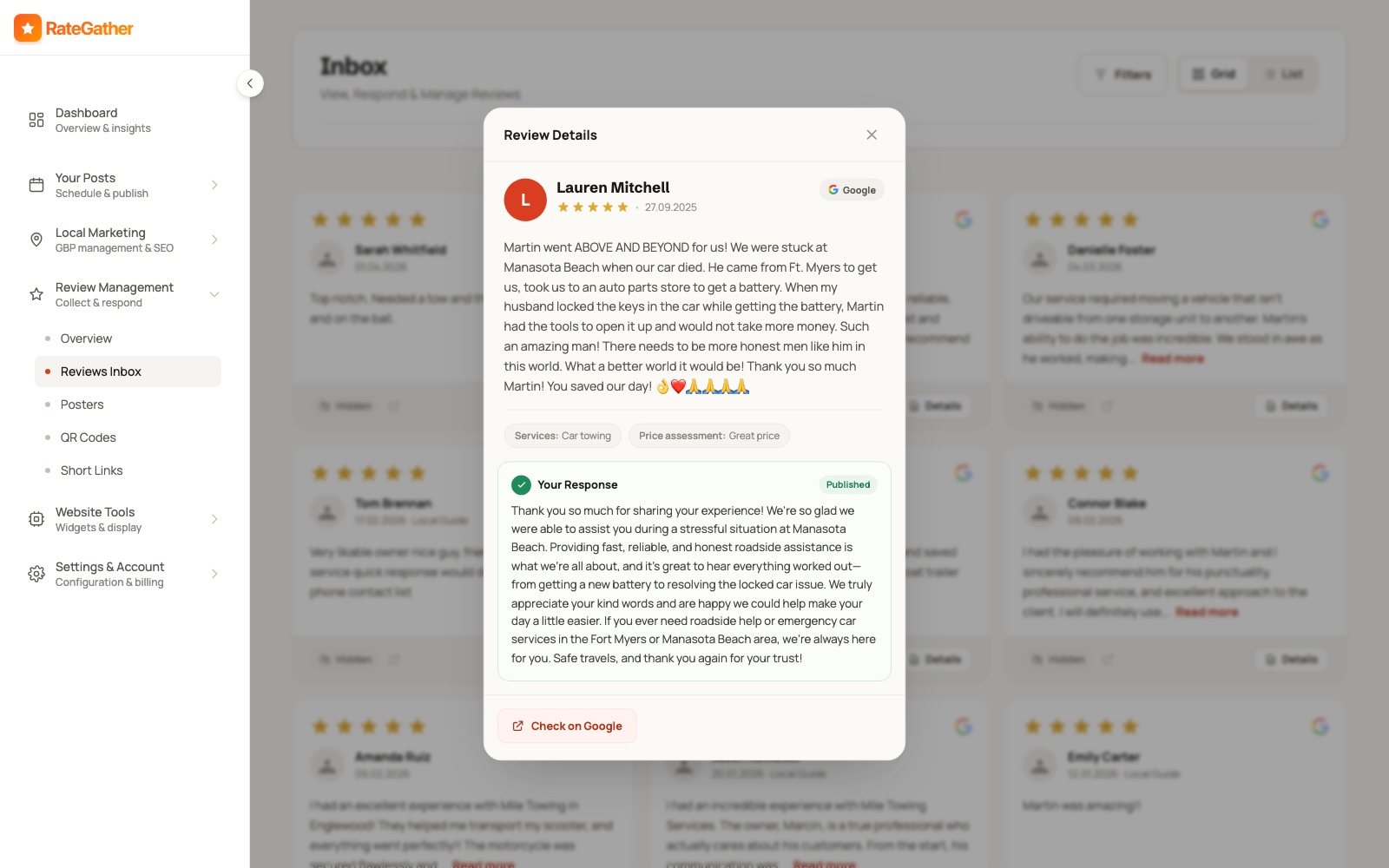
RateGather drafts an on-brand reply the moment a new review lands — positive, negative, or three-star — matched to the tone of your previous replies; you approve each one or let it auto-publish. It generates unlimited review links, QR codes, and email templates on the Autopilot plan (one of each on Free), and this section only covers the ask itself — 16 ways to get more Google reviews is the full tactical playbook, including timing, wording, and exactly what not to do to stay inside Google's policy. The pattern holds across the trade: shops with 50+ reviews clear a skeptical driver's suspicion far more easily than ones with a handful — treat that as a milestone to build toward with steady asks after every job, not a number to chase once and forget.
Step 3
Track Where You Rank, Repair by Repair
A single 'are we #1' check hides more than it shows. Map-pack ranking varies by exact location — a shop can rank #1 two blocks away and #9 a mile down the road, in the same city — and for auto repair it also varies sharply by which repair someone searched for.
That's what a grid rank tracker is for: instead of one search from one point, it checks your position from dozens of points spread across your actual service area and plots them on a real map, so you can see exactly where you're strong and where a competitor is beating you — not a single number that might be true from your bay and false from the next neighborhood over.
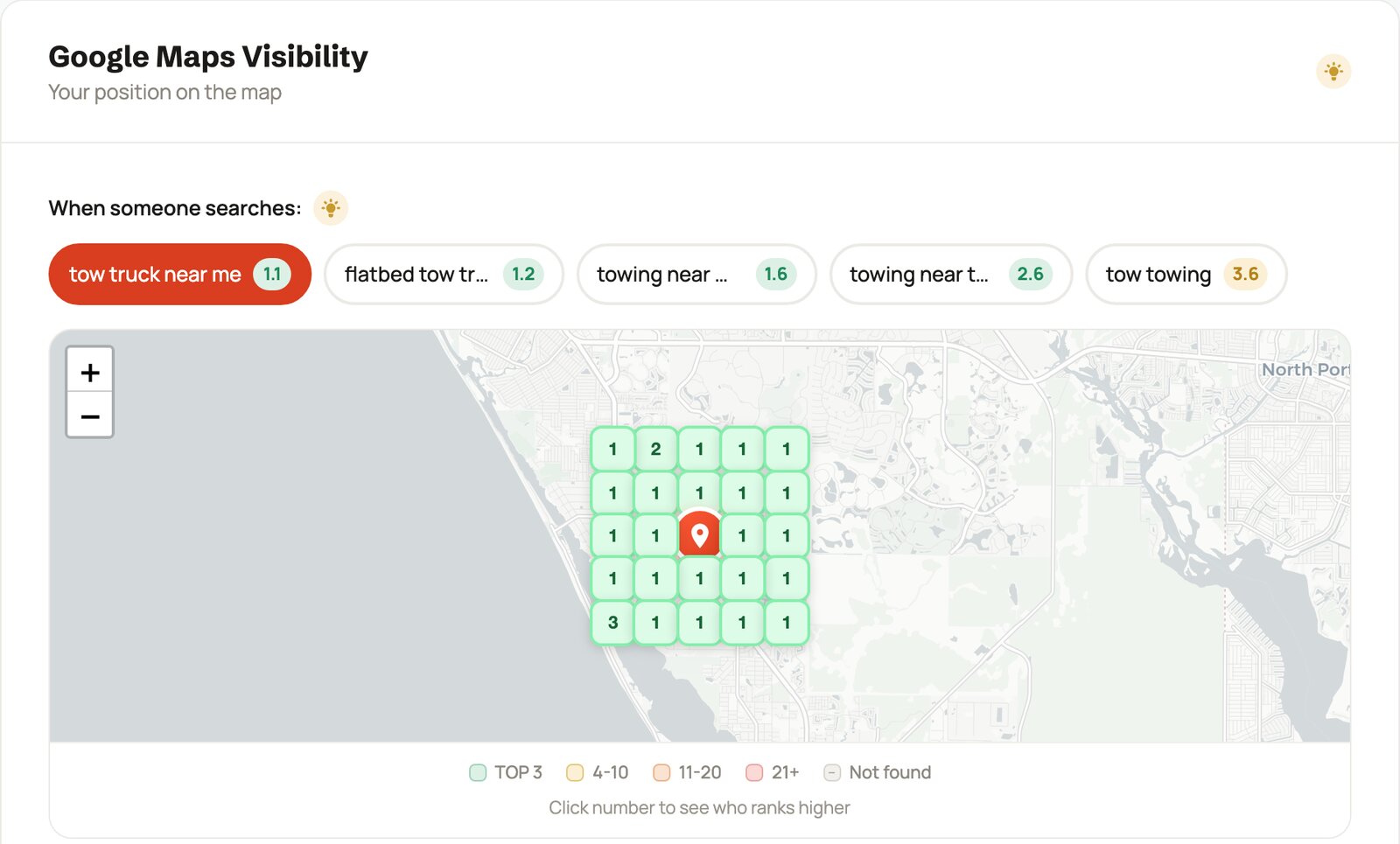
The twist for auto repair is that you're not tracking one keyword — you're tracking a whole menu, and you can rank
completely differently on each. Track the high-urgency, safety-driven searches first — mechanic near
me, brake repair, check engine light, auto repair + [your city] —
alongside the routine, loyalty-building ones like oil change near me and the higher-ticket
transmission repair. The routine searches matter more than they look: an oil change is often how a
new customer tries you out before they'll trust you with a big repair, so ranking for it is your foot in the door
to that multi-year relationship. RateGather runs this as a daily grid check, with 2 reports a month on Free and 30
a month plus competitor monitoring on Autopilot, so you can see exactly which repair category a competitor is
outranking you on and by how much.
Some of that mix also swings with the calendar, and your tracked keywords should follow it: AC and cooling-system
searches climb in summer, battery and heater complaints spike with the first cold snap, and pre-road-trip
inspection and tire searches lift ahead of the holidays. Tracking only your evergreen terms all year misses the
seasonal ones converting right now. Competitor monitoring on Autopilot pairs with this well — if the chain down the
street jumps ahead of you on brake repair right as school starts back and everyone's servicing the
family car, that's the week to know, not next quarter.
Check your shop's ranking, free
Run a real 9-point grid check for any keyword and location, no signup or credit card required — see exactly where you rank for 'mechanic near me' or 'brake repair' around your own shop right now.
Step 4
Create Content That Answers Car Questions — and Proves You're Honest
The questions people search — and increasingly ask an AI assistant — are specific and repair-by-repair: what a check engine light means, whether that brake noise is urgent, whether they should go to the dealer or an independent shop. Content that answers those plainly is what shows up for them, and for an auto shop it does a second job: it puts your honesty in writing before anyone walks in.
This isn't about generic "why choose us" pages. A profile and a site that keep publishing — Google Business Profile updates plus a handful of articles a month, tuned to your specific services and area — read as active; one frozen since last year reads as abandoned, to both a driver scanning results and an AI assistant weighing which shop to recommend. The auto-repair-specific advantage is that useful, straight-talking content is itself a trust signal: a shop that explains, in public, which repairs are urgent and which can safely wait is telling every reader it isn't in the business of manufacturing panic. Framed honestly, this makes you more likely to show up in Google and AI recommendations for the questions your customers actually ask — it's not a ranking guarantee, and nobody who promises otherwise is being straight with you.
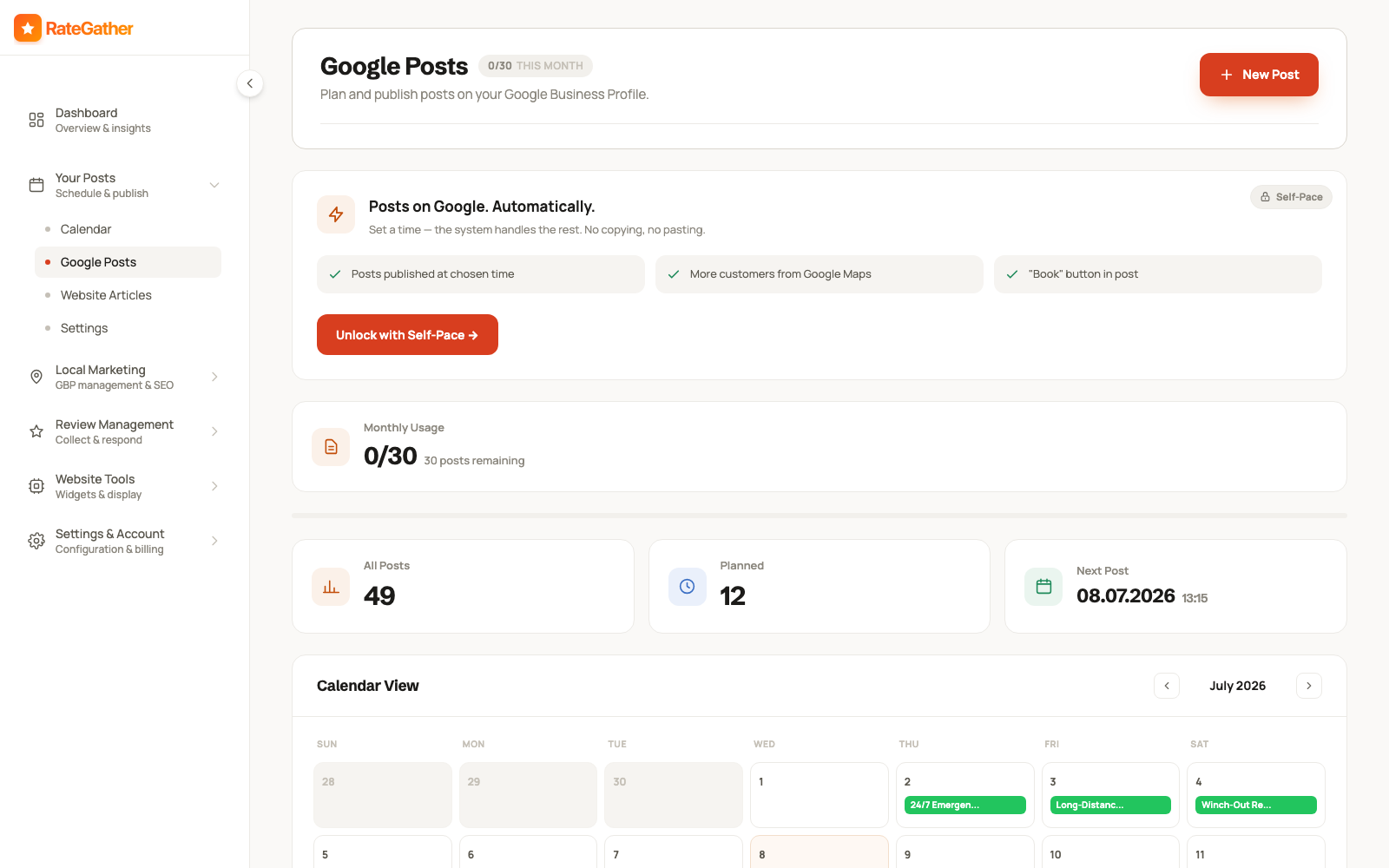
Because auto searches split by repair type, each category is its own content opportunity. A handful of topics cover most of what drivers actually search for, and they double as genuinely useful Google Posts or short blog articles:
- What a check engine light actually means — the difference between a loose gas cap you can drive on and a flashing light that means pull over now.
- Brake noises decoded — which squeals and grinds are normal, which mean pads, and which are a safety issue you shouldn't wait on.
- How often you really need an oil change for your car and driving habits, cutting through the "every 3,000 miles" myth.
- Signs of a failing transmission, and why an early diagnosis is far cheaper than a rebuild.
- Dealer versus independent shop — an honest breakdown of when a dealership makes sense (warranty, recalls) and when a trusted independent saves you money on the same work.
- A simple pre-road-trip checklist, and what a seasonal check-up should actually cover before summer heat or winter cold.
That dealer-versus-independent article is worth singling out. It's a real, high-intent search — a driver actively weighing whether to trust a shop like yours over the dealership — and answering it fairly, admitting the cases where the dealer is the right call, is more persuasive than a one-sided pitch, and it captures a search a defensive competitor won't touch. Pair every one of these with a matching item on your website's content calendar, so the same topic reinforces your profile and your site at once instead of living in only one place.
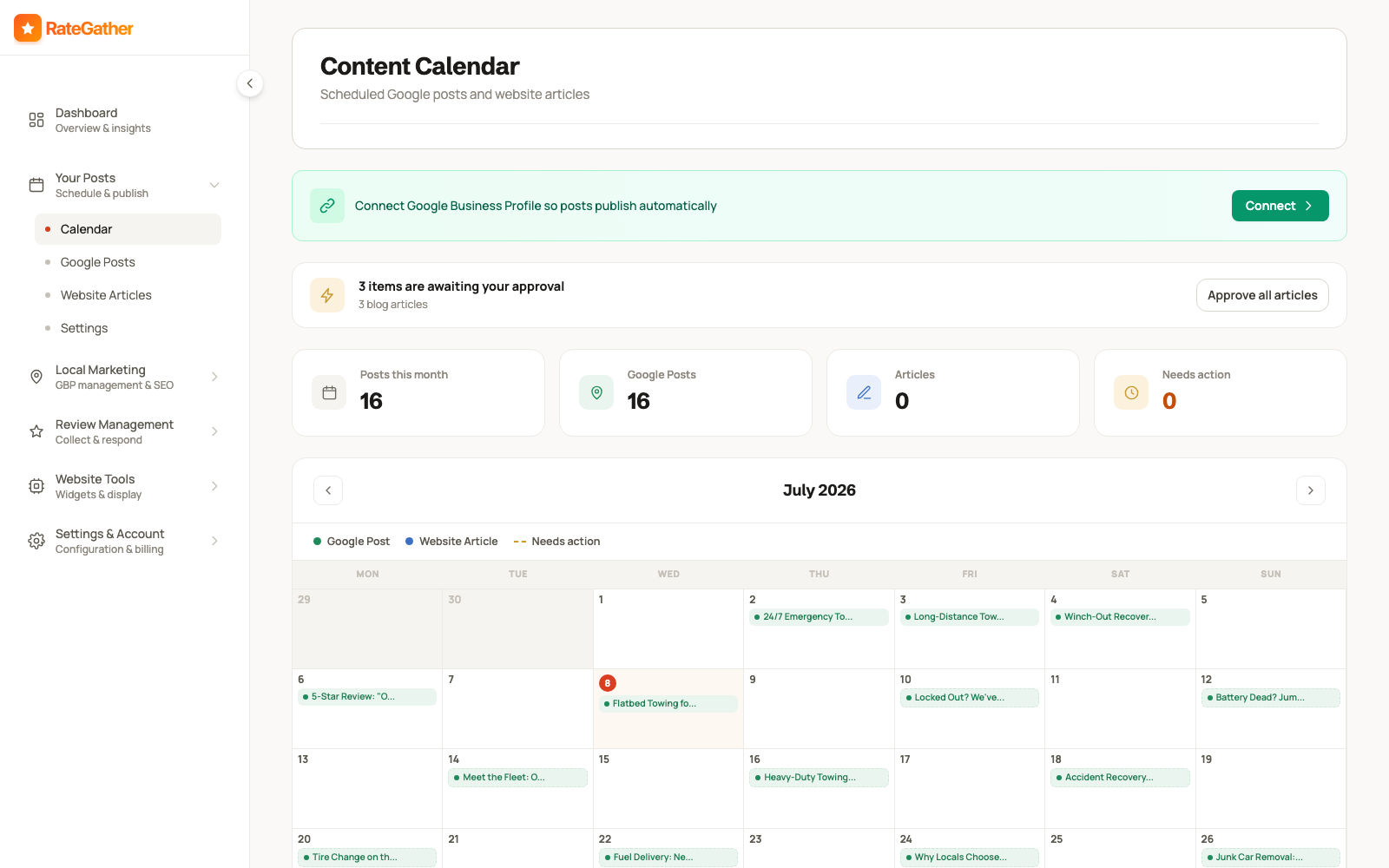
RateGather's AI drafts Google Business posts and blog articles about auto repair topics — maintenance tips, what a warning light means, repair explainers — on a schedule you set, then you either approve each one or let it auto-publish. Free includes 1 AI Google post and 1 blog draft a month; Autopilot includes 30 posts and 6 articles a month, enough to cover every repair category and keep a profile and a site both looking active without writing any of it yourself.
Step 5
Keep NAP and Listings Consistent
NAP is your Name, Address, and Phone number — and it has to read the same everywhere it appears: your Google Business Profile, your website, and every directory or mechanic-finder tool that lists your shop.
Inconsistencies creep in without anyone noticing. A shop that moved down the block still shows the old address on one directory; the website says "Ave." while the profile says "Avenue"; the phone number you added for the service desk got updated in two places but not the third. On its own, no single mismatch will bury you. In aggregate, though, conflicting details make Google less certain that every mention of your shop points to the same real business at the same address, and that uncertainty is a drag on how confidently it ranks you. It's worth a deliberate pass every few months, not a set-it-and-forget-it task.
Auto repair carries a couple of citation sources most trades don't, so your check should cover more than the usual suspects. Alongside your website's footer and contact page, your Google Business Profile, and the general directories a shop tends to land on — Yelp, Angi, Nextdoor, the Better Business Bureau, your local chamber of commerce — look at the auto-specific finders: RepairPal and CarMD certified-shop listings, the AAA Approved Auto Repair directory if you're a member, and any manufacturer or parts-network locator like NAPA AutoCare that carries your details. An outdated address or a dead phone number on one of those sends the same mixed signal as any other stale citation. Search your shop's name plus your city and see what surfaces; leftover listings from a former location or a disconnected line are common, and it's worth requesting a correction or removal rather than leaving wrong information live where a stranded driver might dial it.
To keep the product and the practice clearly separated: RateGather doesn't scan citations for you, so this step stays a manual one. What it can do is make the confirmation easy on the one property you fully control — your own website. Publishing LocalBusiness structured data that carries the exact same name, address, and phone as your profile gives search engines a clean, machine-readable match to check your site against your listing. RateGather's free local business schema generator builds that valid JSON-LD for an auto shop in a few minutes, no signup required.
Putting it together
These Five Steps Aren't a Checklist You Finish Once
Run all five one time and you'll get a short-term bump. The shops that keep the bays full treat them as a loop — and for auto repair, that loop pays back longer than almost any other trade, because the customers you earn stay.
Here's what makes the auto-repair version of this loop different from a plumber's or a roofer's. When you win a customer's trust, you don't win one job — you win a driver who stops shopping, comes back for the oil change and the inspection and the next repair, and sends their spouse and their neighbor your way. So every honest review you bank, every warning-light article you publish, every "no upselling" mention on your profile isn't just working on the next search; it's compounding into a base of repeat customers who cost you nothing to keep. That's the whole reason the effort is worth sustaining rather than doing once.
And the parts that build that trust are exactly the parts that go stale if you stop. A profile set up in spring and never touched reads as less active by fall. Reviews you quit asking for taper off, right when a new driver is deciding whether to believe your record. Content published once stops answering the questions people are searching this week. The shops that consistently show up first, and keep the customers they find, aren't the ones who did local SEO for a month — they're the ones who kept the GBP current, kept asking for honest reviews on every job, watched the grid across every repair category, and kept publishing, on a rhythm measured in weeks.
That's why RateGather is software instead of a one-time audit. The free tools above — review link generator, rank checker, schema generator — work fine as manual, one-off checks whenever you want them. The app's job is the repeating half of the loop: keeping posts shipping, reviews monitored, and rank reports running while you're under a hood and not thinking about marketing at all.
What it costs
What This Costs
No hidden retainer, no setup fee — the exact figures an auto repair shop sees on RateGather.
Free — $0/mo
Autopilot — $79/mo ($63/mo yearly)
See the full feature-by-feature breakdown for an auto repair shop on /industries/auto-repair, or compare against the wider local SEO category on pricing.
Straight answers
Frequently asked questions
Months rather than days, and how many depends on how many shops you're up against and where you're starting from. There's a bright side unique to a repair shop, though: because customers pick a mechanic to keep, the payoff doesn't stop when they show up once — a driver who finds you for a brake job comes back for oil changes and inspections for years. Watch the trend on your grid rank tracker over weeks, not a promised date or ranking position, and judge from where it's heading.
There's no official number, but the bar is higher for auto repair than for most trades, because drivers walk in already braced to be overcharged. Shops with 50+ reviews clear that suspicion far more easily than ones with a handful, and the reviews that do the heavy lifting are the ones that mention fair pricing and no upselling by name — not just "great work." Treat 50 as a milestone to build toward with steady asks, not a finish line.
A text with your direct review link, or a QR code on the invoice, handed over at pickup — the moment the car runs right and the final bill matched the estimate. That combination, a working car and no surprise on the total, is exactly the relief you want fresh in the customer's mind when they tap through. Telling someone to "look us up on Google later" loses most of the ask. See RateGather's free review link generator to build yours.
You don't script the review — that would read as fake — but you do earn the words by how you run the job: show the customer the worn part you replaced, explain what was optional versus necessary, and keep the final bill on the estimate. Drivers who were treated that way tend to say so unprompted, and those specific, honesty-focused reviews are the ones that convert the next skeptical searcher. Replying to them the same way, thanking a customer for trusting you with the diagnosis, reinforces the signal for everyone scanning your profile.
Google Business Profile is the highest-leverage single asset for a "mechanic near me" search — it's usually what a driver sees first, before any website gets a click, and for someone stranded or on a tow it may be all they look at. But a website is where a cautious customer confirms you before a bigger repair: your certifications, your warranty, your service list, and honest explainers about common repairs. Neither replaces the other — see websites for auto repair shops for that side.
It helps you show up for the specific questions drivers, and increasingly AI assistants, ask about car trouble — "what does a check engine light mean," "do I really need new brakes," "dealer or independent mechanic" — not a guaranteed ranking boost. A profile and site that keep publishing read as active; ones frozen for a year read as abandoned. Treat AI content as a way to be present, and to prove your honesty in writing, for the questions your customers are already asking, not a shortcut around the rest of this guide.
Yes. Sending the review link only to customers you already know were happy, or routing an unhappy one to a private email instead of the public review form, is called review gating, and it's explicitly against Google's own review policy. For a shop fighting a trust deficit it's also self-defeating: a spotless wall of five-stars reads as suspicious, while an honest three-star with a level-headed reply reads as a shop that owns its mistakes. Ask every customer, every time — see 16 ways to get more Google reviews for the full, policy-safe playbook.
Two plans. Free at $0/mo covers the basics a shop needs to see where it stands: 1 ranking report, 1 AI Google post, 5 AI review replies a month, QR codes, and a review widget. Autopilot at $79/mo ($63/mo billed yearly) runs the recurring work across every repair category: 30 ranking reports, competitor monitoring, daily review checks, 30 AI Google posts, and 6 blog articles a month. No credit card required to start on Free.
This page is the how-to: the five-step framework, in order, with the reasoning behind each step. /industries/auto-repair is the shorter product page — what RateGather specifically does for a repair shop, and what it costs. Read this one first if you want the playbook; go there if you already know you want the software.
This guide is the playbook. For the wider category beyond auto repair, see local SEO services; for the auto-repair-specific product page with the full feature list, see /industries/auto-repair; and if you also need the website that turns those clicks into booked jobs, see websites for auto repair shops — the sort of site behind our Redstone Auto Care demo (a fictional demo shop we built to show the format).
Become the shop drivers find, trust, and keep.
Free plan available, no credit card required.
No contract. No ranking guarantees. Cancel anytime.