Local SEO Metrics That Drive Revenue for Small Businesses
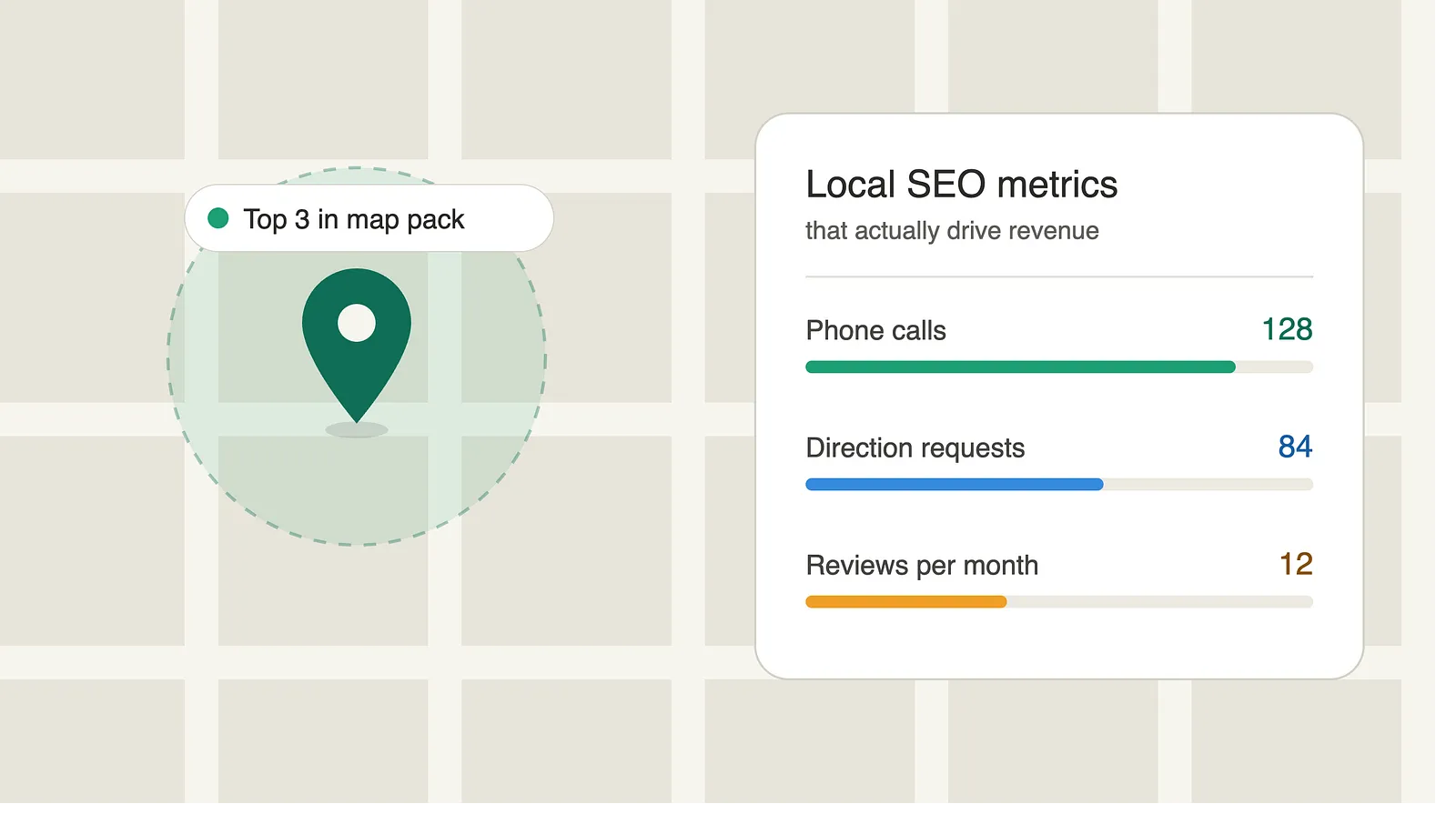
Most small business owners track dozens of SEO metrics, but only a handful directly impact revenue. Knowing which numbers to watch (and which to ignore) can save you hours of wasted effort and help you focus on what actually drives customers through your door.
Why Most Local SEO Metrics Are Noise
Open any analytics dashboard and you'll drown in numbers. Impressions, clicks, bounce rates, time on site, pages per session. The problem? Most of these metrics tell you nothing about whether your phone is ringing or your calendar is filling up.
For a local business, the question isn't 'how many people saw my listing?' It's 'how many people called, visited, or booked?' That shift in thinking separates businesses that grow from those that just collect data.
The metrics that matter are the ones closest to a transaction. A map view means someone is looking for you. A direction request means they're on their way. A phone call means they want to buy.
Google Business Profile Actions: Your Revenue Thermometer
Your Google Business Profile tracks four actions: website clicks, direction requests, phone calls, and message sends. These aren't vanity metrics. Each one represents a person who found your business and took a step toward becoming a customer.
Direction requests are gold. Someone who asks for directions is almost certainly coming to your location. Track this number weekly. If it drops, you have a visibility problem. If it rises but foot traffic doesn't, you might have an expectation mismatch between your listing and what customers find when they arrive.
Phone calls from your listing tell you two things: your listing is appearing for the right searches, and your business looks trustworthy enough to contact. Compare call volume to your actual booked appointments or sales. The gap between calls and conversions points to where your sales process needs work.
Tracking Calls Beyond the Dashboard
Google's call data is useful but incomplete. It shows total calls, not which ones converted. Use call tracking software that records conversations (with consent) or assigns unique phone numbers to different marketing channels. This tells you which searches and listings actually generate paying customers, not just curious callers.
Seasonal patterns matter. Track calls month over month and year over year. A dip in February might be normal for your industry, or it might signal a competitor outranking you.
Map Pack Rankings: Visibility Where It Counts
Ranking in the top three map results for your core services drives more business than ranking tenth in organic search. The map pack appears above organic results for most local queries, and mobile users rarely scroll past it.
Track your map pack position for your five most important search terms. Not generic terms like 'restaurant' but specific ones your customers actually use: 'Italian restaurant downtown' or 'emergency plumber near me.' Use a rank tracking tool that checks from different locations within your service area, because Google personalizes results based on where the searcher is standing.
If you rank fourth or fifth, you're invisible to most searchers. The difference between position three and position four is enormous. Focus your optimization efforts on breaking into the top three for one high-value term before chasing rankings for twenty mediocre ones.
Review Velocity and Response Rate
Review count matters less than review velocity: how many new reviews you get each month. Google's algorithm favors businesses that consistently earn fresh reviews. A business with fifty reviews from last year looks stale compared to one with thirty reviews from the past three months.
Track two numbers: reviews per month and your response rate. Responding to every review, positive and negative, signals to Google that you're an active, engaged business. It also shows potential customers that you care about feedback.
Set a goal based on your transaction volume. If you serve ten customers a week, aim for eight to ten reviews per month. That's roughly one review for every four or five customers. If you're getting fewer, your review request process needs work.
What to Do With Negative Reviews
Negative reviews hurt, but they're also a metric. A spike in complaints about the same issue (slow service, hard-to-find location, confusing pricing) tells you what to fix. Respond publicly and professionally, then address the root cause.
Track the ratio of positive to negative reviews. A healthy local business typically maintains at least an 85% positive rate. Below that, you have operational problems that SEO can't solve.
Website Traffic From 'Near Me' and Local Searches
Not all website traffic is equal. A visitor from 'best CRM software' is researching. A visitor from 'accountant near me' is ready to hire. Segment your analytics to isolate traffic from local search terms.
In Google Analytics, create a custom segment for users who arrived via searches containing your city name, 'near me,' or your neighborhood. Measure this group's conversion rate separately. If local traffic converts at 8% but general traffic converts at 2%, you know where to focus your effort.
Track which pages local visitors view most. If they land on your homepage but never reach your services or contact page, your site navigation is failing. Local searchers want your address, phone number, and hours immediately. Bury those details and you lose them.
Citation Consistency Across Directories
Citations (mentions of your business name, address, and phone number on other websites) build trust with Google. But inconsistent citations (different phone formats, abbreviations, suite numbers) create confusion and dilute your authority.
Audit your top twenty citations quarterly. Use a spreadsheet or citation management tool to check that your NAP (name, address, phone) matches exactly across Google, Yelp, Facebook, industry directories, and local business listings. Even small discrepancies ('Street' vs 'St.') can hurt.
Don't chase hundreds of low-quality directories. Focus on the ones your customers actually use and the ones Google trusts: your chamber of commerce, industry associations, and major platforms like Bing Places and Apple Maps.
Conversion Rate: The Only Metric That Pays the Bills
You can rank first, get a thousand map views, and earn fifty reviews, but if none of that turns into revenue, it's worthless. Conversion rate is the percentage of people who take your desired action: book an appointment, request a quote, make a purchase, walk through your door.
Define what a conversion means for your business, then track it religiously. For a service business, it might be form submissions or booked calls. For a retail shop, it's foot traffic or online orders. Measure conversions from each traffic source separately (Google Business Profile, organic search, paid ads) so you know what's working.
If your conversion rate is below 3% for local traffic, you have a messaging or trust problem. Visitors are finding you but not buying. Test clearer calls to action, simpler contact forms, visible trust signals (reviews, certifications, years in business), and mobile-friendly design. Small changes here often matter more than ranking improvements.