How Local SEO Works
Local SEO pulls on several signals at once, and Google weighs all of them together when deciding which businesses to show for a nearby search:
- Google Business Profile. Your free listing — categories, hours, photos, posts, and Q&A — is the biggest single factor for map-pack visibility. See What Is a Google Business Profile?
- Reviews. Volume, recency, star rating, and whether you reply all feed into how trustworthy your business looks to both Google and the searcher.
- NAP consistency. Your name, address, and phone number need to match exactly across your website, your profile, and every directory that lists you. See What Is NAP?
- Local content. Pages and posts that mention your service area and specific services give search engines more context for where and what you do.
- Proximity and relevance. How close a searcher is to your business, and how well your category and listing match what they searched, are factors you can't fully control but can optimize around.
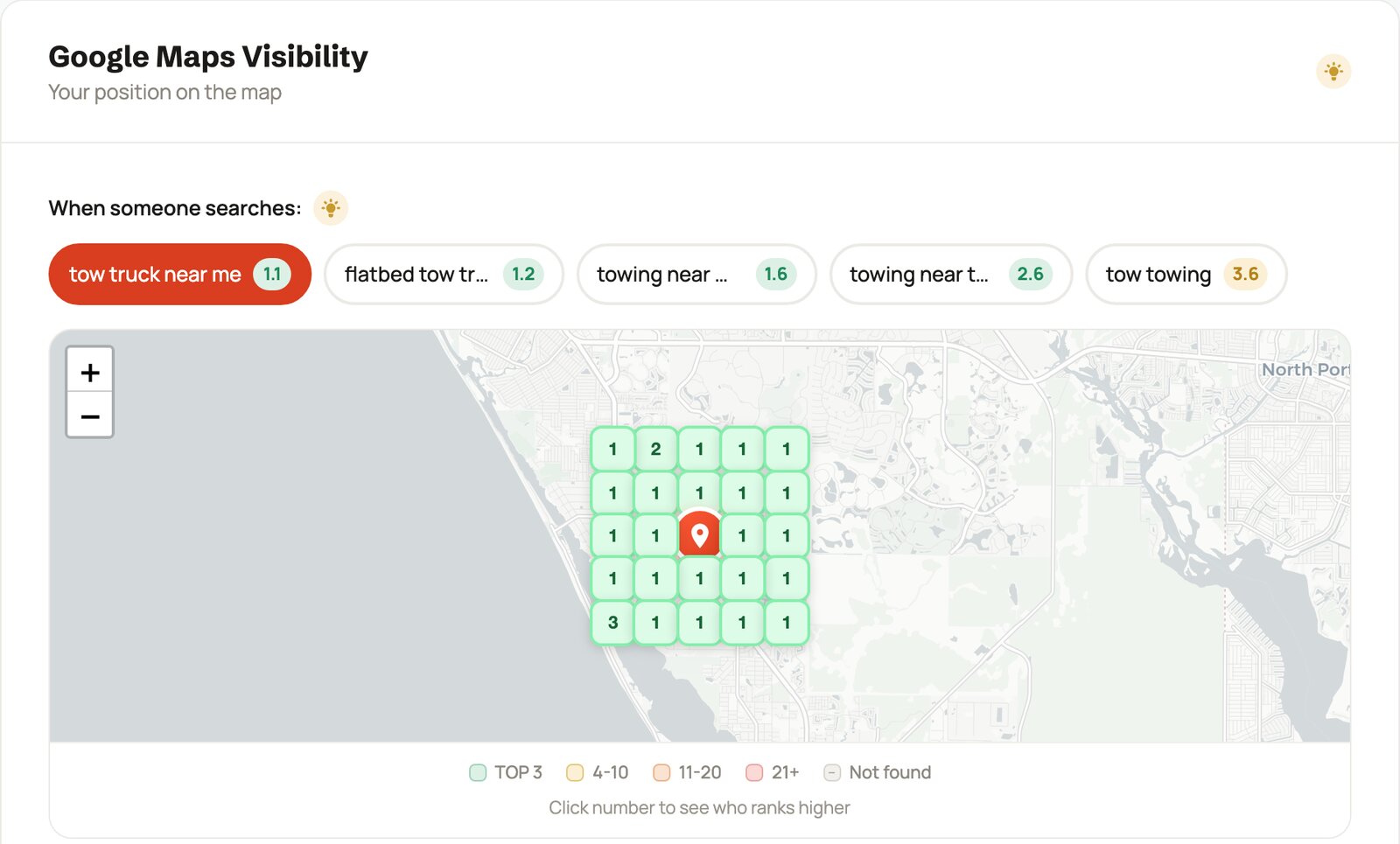
Because ranking position can differ from block to block, agencies and tools track it with a "grid" — checking your position from many points across your service area instead of one single search. RateGather's dashboard runs this as a daily rank grid; you can also run a free one-off check with the local rank checker.
Why It Matters for Local Businesses
For any business that depends on people nearby finding it, the map pack and local results are where the customers actually are. Local searches skew heavily toward action: someone searching "plumber near me" is usually closer to calling than someone browsing general search results. Showing up above your competitors in that map pack, with strong reviews and an active-looking profile, is often the difference between the phone ringing and the search ending on a competitor's listing instead.
Unlike paid ads, local SEO work compounds — a well-optimized profile, a steady flow of reviews, and consistent content keep working after the initial effort, rather than stopping the moment you stop paying for clicks.
Common Mistakes
- Inconsistent NAP data. A different phone number or address format on one directory than on your website or profile can undermine the trust signal Google is looking for.
- An unclaimed or half-filled Google Business Profile. Missing categories, no photos, and no posts read as an inactive business.
- Ignoring reviews. Not responding to reviews, especially negative ones, is a missed trust signal — and a missed chance to show future customers how you handle problems.
- Treating it as a one-time project. Local SEO is ongoing; profiles that go quiet tend to slide back down as more active competitors keep posting and collecting reviews.
- No local content. A site that never mentions the specific area or services you serve gives search engines less to match you against.
Want the full walkthrough of what's involved, including how RateGather automates the ongoing parts? See local SEO services.
Frequently asked questions
- What is the difference between SEO and local SEO?
- SEO covers ranking for any search, anywhere. Local SEO specifically targets searches tied to a physical service area — a Google Business Profile, local reviews, and nearby-relevant content matter far more here than they do for general SEO.
- How long does local SEO take to work?
- Typically months, not days, and it depends on competition in your market. Early movement often shows in weeks 4-8; sustained gains compound over 3-6 months and beyond. Nobody can honestly guarantee a timeline or a specific ranking position.
- Do I need a website for local SEO?
- It helps significantly — your Google Business Profile links to it, and it's where local content and service pages live. You can still show up in the map pack without one, but a website gives search engines more to work with.
- Is a Google Business Profile the same thing as local SEO?
- No — it's the single highest-leverage piece of local SEO, but not the whole discipline. See What Is a Google Business Profile? for the dedicated breakdown.
Related terms
The free listing that controls how you appear on Google Search and Maps.
What Is NAP?The name, address, and phone number consistency that local search relies on.
GBP Ranking Factors That Actually MatterGoogle's own documented factors — relevance, distance, prominence — and which claims are myths.
What Is the Local 3-Pack?The specific block of results local SEO is trying to earn a spot in.